


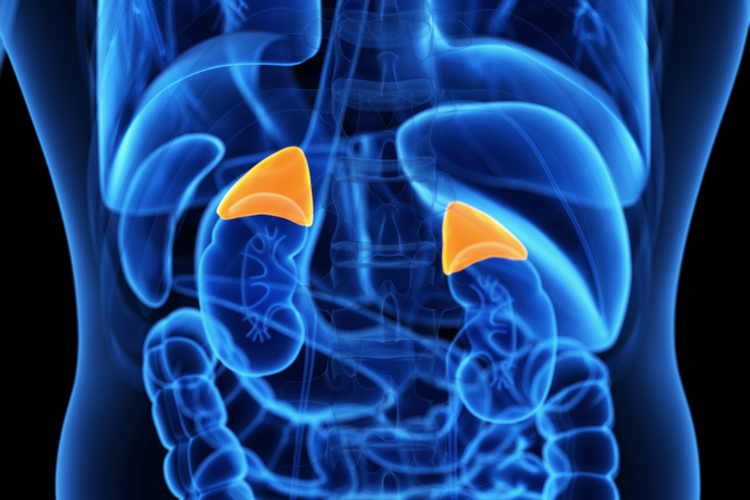
Each kidney has two adrenal glands, which are tiny structures on top of each kidney. Their shapes are different: the right is pyramidal, while the left is semilunar.
They are responsible for producing hormones essential for life, and their function is to regulate responses to stress through the synthesis of corticosteroids (primarily cortisol) and catecholamines (adrenaline).
Cortisol helps to respond to stress, among other functions.
The adrenal glands are also not located in the same place. The left adrenal gland is not entirely superior but medial.
These glands are supplied by branches of the inferior phrenic artery, the middle adrenal artery (an extension of the abdominal aorta), the superior polar artery (which comes from a branch of the renal artery), and the external arch of the kidney.
the function of the adrenal glands
The adrenal glands are small but have an essential function in the body. They produce multiple hormones involved in development growth, affect our ability to handle stress, and regulate kidney function.
Thus, the adrenal glands have two functions, one nervous and one endocrine:
- Endocrine function. They secrete hormones that intervene in the regulation of electrolyte/water balance. Also, other hormones maintain the correct glucose, proteins, and fats, with catabolic, anti-inflammatory, and thermogenic functions. They also produce anabolic and masculinizing hormones.
- Nerve function. The glands allow us to give a correct response to stress.
Pathologies that the adrenal glands can suffer
It is essential to know the pathologies affecting the adrenal glands to understand their structure. The adrenal gland is divided into two parts:
- Medulla, which produces adrenaline and noradrenaline, are responsible for activating the heart rate and breathing.
- Cortex generates glucocorticoids (hydrocortisone) and is responsible for mobilizing the energy needed.
The brain is the one that processes all the information and activates the different systems of the body, depending on the situations we face, so the influence on the adrenal glands will come from there. The diseases that the adrenal glands may suffer will depend on the affected area, and there may be both excess and defect of production and mixed pictures.
On the other hand, tumors can also cause the adrenal glands, and bleeding and infections can cause adrenal problems.
Thus, if there is excessive production of hormones, the alteration is in the gland itself, and the symptoms that the patient has will depend on which hormone is being produced in excess:
- Increased hormones are similar to testosterone. Sometimes it occurs mildly and only as hair growth (hirsutism).
- Cushing’s syndrome. It is an overproduction of corticosteroids, which can have several causes. It may be due to adrenal carcinoma, adrenal adenoma, or adrenal hyperplasia if it is primary. If it is secondary, it may be due to an ACTH-secreting pituitary microadenoma (Cushing). Due to the hypothalamic hypersecretion of CRH, a tertiary one may or may not be a tumor. At the same time, there can be an economic secretion of ACTH, something frequent in patients with bronchial carcinomas, or ectopic secretion of CRH (in carcinoid tumors). Or an iatrogenic one due to chronic use of ACTH or cortisol.
When corticosteroids are given in excess, the distribution of body fat is altered, so that patients tend to have a characteristic appearance: a full moon face, a lot of fat in the torso, loss of muscle mass with weakness, skin fine, red stretch marks in the abdomen area.
In addition, other pathologies can be:
- Hyperaldosteronism or hyperproduction of Aldosterone . It is the hormone responsible for regulating ions at the kidney level, such as sodium, chlorine, bicarbonate, and potassium. Its increase modifies blood concentrations, with blood pressure, among others. Normally its cause is tumoral, but not always cancerous.
- Excessive secretion of catecholamines (adrenaline, dopamine, noradrenaline) is normally produced by a tumor (pheochromocytoma) that affects the adrenal glands. The increase in these catecholamines produces an increase in blood pressure, and, sometimes, patients suffer from panic attacks, with a rapid pulse, excessive sweating, palpitations, increased respiratory rate.
On the other hand, there are pathologies of the adrenal glands caused by low production of hormones:
- Diseases of the adrenal glands usually cause Addison’s disease. Its main causes are Autoimmune Adrenalitis or Tuberculosis. Still, other causes can be disseminated intravascular coagulation, fungal infections, surgeries, Amyloidosis, drugs that inhibit enzymes that synthesize cortisol, AIDS, or other congenital disorders.
When there is a deficiency of hormones in the body, different disorders can occur:
- Problems maintaining adequate levels of potassium and sodium in the blood.
- Since the kidney cannot store urine, the patient needs to go to the toilet frequently. In addition, dehydration and shock can occur.
- More sensitivity to insulin, with decreased blood sugar levels.
- Accumulation of the hormones that the brain produces to stimulate the adrenal gland affects melanin production (skin pigment).
Treatments for pathologies of the adrenal glands
Specialists will employ various surgical and pharmacological treatments for diseases of the adrenal glands, which may include:
- Medications to stop the excessive production of hormones.
- Hormone replacement.
- Surgery to remove tumors of the adrenal glands or, if necessary, surgery to remove one or both glands.
In Cushing’s syndrome, treatment will depend on the cause. For example, if there is an excess of cortisol due to a medication, the specialist may change the dose or change the medication.
However, medications or radiation therapy may be given if the body produces too much cortisol.
In pheochromocytoma, the usual treatment is resectioning the tumor, which improves the patient’s blood pressure.
In Addison’s disease, the body’s missing cortisol or aldosterone is replaced. In addition, patients will receive daily hormone replacement medications and be advised to eat more salt.
In hyperaldosteronism, treatment will depend on what is causing the disorder. Thus, the effect of aldosterone may be blocked, or the adrenal gland should be resected in cases of tumors.